
Chapter 1 · Arch support removal
Smash Fest Level 5 Guide — Remove the Glass-and-Wood Arch Support
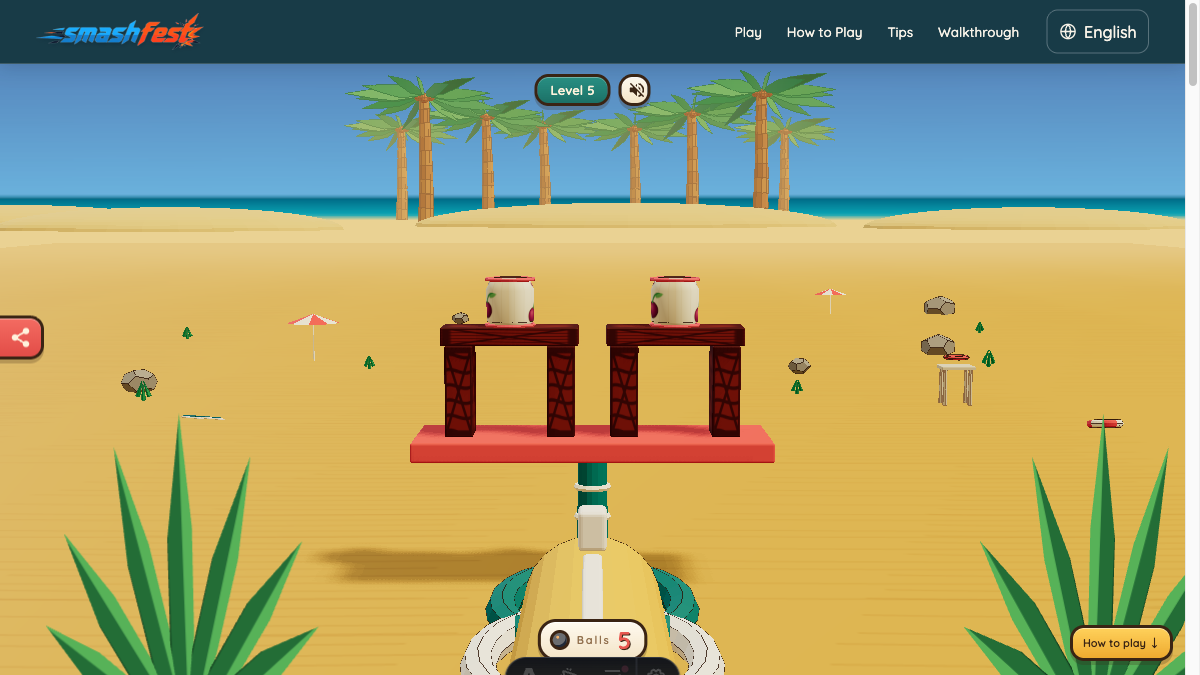
Level 5 is an eight-objective arch built from wood and glass. It spans wider than the earlier compact walls, rises to a little over three world units, provides five cannonballs, and sets a two-shot par. The level's explicit strategy is support. Rather than chasing the highest glass, look for the lower wooden or glass contact that carries the arch above it.
An arch can look open in the middle and still be stable because its load travels through both sides. Removing one support creates rotation, but the opposite side may continue holding a partial span. The two-shot plan therefore assigns one deliberate opening to a supporting side and keeps the second for the stable base or isolated objective revealed by the collapse.
Cannonballs
5Materials
Wood · GlassPar
2Targets
8Identify what holds the arch up
The structure uses three nominal columns and two rows, but the arch pattern distributes eight targets across a broad horizontal footprint. Wood behaves as a support that can be toppled; glass can break directly or during the fall. The useful targets are not automatically the most fragile ones. A glass piece high in the span may shatter without changing the two lower paths carrying the structure.
Before firing, compare the lower left and lower right supports. Choose a side where the falling span has open space and where the shot can travel through the support rather than skim above it. Keep the opposite lower side in mind as the likely second aim, but let the actual collapse decide.
Opening plan: remove one load path
Place the reticle on a low support at one side of the arch. A wood support benefits from a hit that topples it into or away from the span; a glass support benefits from a clean direct contact. The purpose is to make the upper section lose one of its two stable paths and rotate under gravity.
Do not shoot through the empty arch opening. Empty space cannot transfer force into the structure. After the support moves, watch the top and the opposite side. Falling glass may clear itself, and displaced wood may strike another objective after the first visible drop.
Step-by-step Level 5 plan
Choose a lower side support
Aim at a load-bearing target near the left or right base. Favor the side with room for the span to rotate and keep the reticle centered on the material.
Let the span rotate
Fire once, then wait while the upper targets fall toward the opened side. Track glass breakage, wood movement, and the remaining-target counter.
Attack the support that stayed stable
If a partial arch remains, place shot two on its lowest stable contact. Do not aim at the original location after that support has already moved.
Recover by material
Use a reserve ball for direct glass contact or to push a grounded wooden objective toward an edge. Wait for each heavy piece to stop before firing again.
Why support removal controls an arch
The upper portion of an arch remains elevated only while force can travel into stable lower contacts. Removing one of those contacts does more than clear one objective: it changes the balance of every target resting across that side. Gravity then rotates the span and produces collisions the cannonball did not need to make directly.
Wood and glass complement this plan. Wood can carry and then redirect the falling load as it topples, while glass can disappear during the same motion. Aiming at support uses both behaviors. A top-first shot uses only the fragility of one visible piece and leaves the structure's main balance intact.
Alternative when the arch drops flat
Sometimes the first support removal lowers the whole span onto the platform without sending every objective off it. In that case, stop aiming where the arch used to be. Find the lowest exposed glass for a direct break, or drive a grounded wooden target toward the nearest edge. The remaining problem is now a flat cluster, not an arch.
Common Level 5 mistakes
Shooting through the opening
The empty center is visually inviting but applies no force. Move the reticle onto a real lower support.
Breaking decorative upper glass first
A high glass clear may leave both load paths stable and spend half of the two-shot plan.
Treating the fallen shape as an arch
After collapse, reassess the actual contacts. A flat remnant needs direct or edge-directed cleanup.
Level 5 replay checklist
- The opening contacted a real lower support, not empty space.
- The upper span received time to rotate and collide.
- Shot two targeted the support or cluster that actually survived.
- Glass and wood were handled according to their behavior.
- Reserve balls were used only after the two-shot support plan settled.
Continue learning
Replay Level 5 from the browser game, then compare the result with the material and support principles in the related guides. Physics can settle differently after small aim changes, so use the visible target count as the final check.